





Sheet metal bending quoting software
Bend count is detected automatically when the 3D part is unfolded. You set your rate and your bands; the price is computed part by part.
Bending is usually charged at a flat price per bend, which loses money on large, thick or short-run parts and loses jobs on long runs. Here the base price per bend is corrected by band multipliers: thickness, number of bends on the part, sheet dimensions and order quantity. If the part comes from a STEP file, the bend count is obtained automatically during unfolding, so it does not depend on somebody remembering to count them.
What the calculation takes into account
Bends counted from the 3D model
Unfolding the STEP counts the bends and produces the flat pattern that goes to cutting. One less figure to type and one less to get wrong.
Band multipliers
Thickness, bend count, dimensions and quantity, each with its own bands and factor. Your real rate, not a closed formula.
Added to cutting in the same quote
For the customer, a cut and bent part is a single line, with the breakdown inside.
Tooling and setup changes
Setup time is spread across the batch, which is what really makes short runs expensive.
AI reads the drawing. Mathematics sets the price.
We use artificial intelligence to understand what you give us: a hand sketch, a photo of the part, a PDF drawing. To calculate the price we never use AI. Cost comes from a deterministic engine using the real geometry and physics of your shop: cut length measured along the contour, your machine's feed rates and accelerations, lead-ins and pierces, real nesting yield, gases, consumables, hourly cost, bending and finishing.
What that means in practice: the same drawing always returns the same price, you can show a customer where every euro comes from, and nothing is ever made up. With machines and materials properly configured, deviation from real shop cost stays under 1%.
- ✓ Reproducible: same file, same price, today and a year from now.
- ✓ Auditable breakdown: material, machine, operations and margin, line by line.
- ✓ Accuracy >99% against real cost when the machine is properly configured.
From part to price in three steps
1 · Upload the file
DXF, DWG, STEP or PDF. A photo, a freehand sketch or a written description also work: that part is read by AI, and the outline is always shown to you before anything is priced.
2 · Pick material and quantity
Your catalogue, your thicknesses, your purchase prices and your machines. No generic online rates.
3 · Instant price and PDF
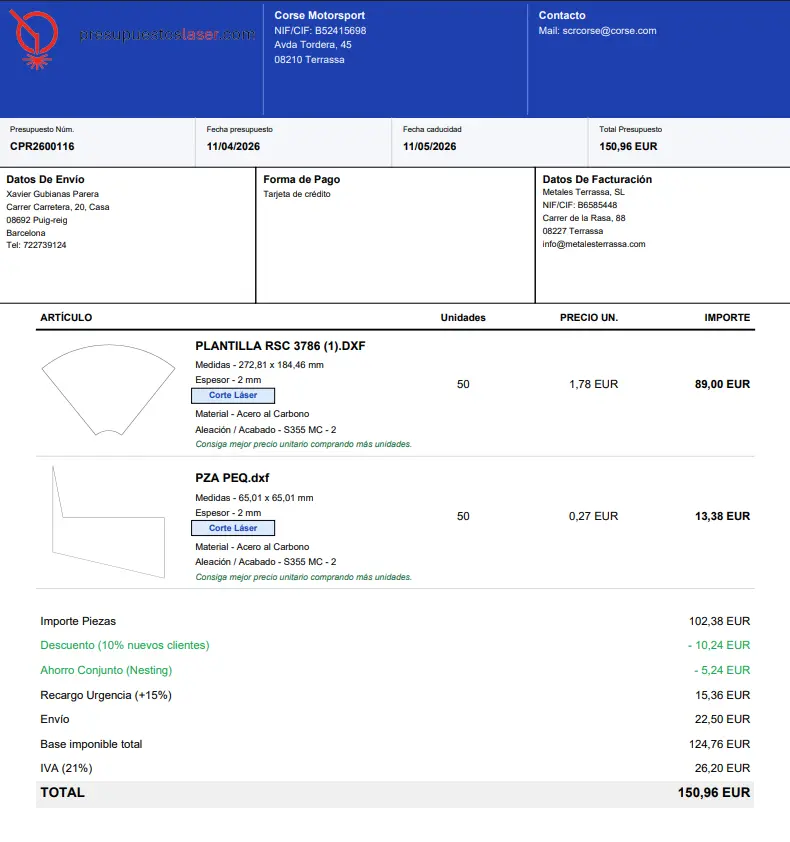
The quote comes out in seconds with a full breakdown, and your customer gets a branded PDF. From there it becomes an order, a delivery note and an invoice without retyping anything.
Frequently asked questions
Where does the bend count come from?
From the 3D part: bends are counted while computing the flat pattern. For 2D or DXF parts you enter the number manually.
Can I charge differently by thickness and quantity?
Yes, that is the whole point: you define bands for thickness, bend count, dimensions and quantity, each with its multiplier over the base price.
Is the press brake handled as another machine?
Yes, with its hourly cost and setup time, just like the cutting machine.
Shall we try it with one of your parts?
Send us a real file and we will send back the quote calculated with your own data, so you can compare it with what you get by hand today.
Talk to us